Geology
Plitvice Waterfalls: The Great Waterfall, Sastavci and How They Form
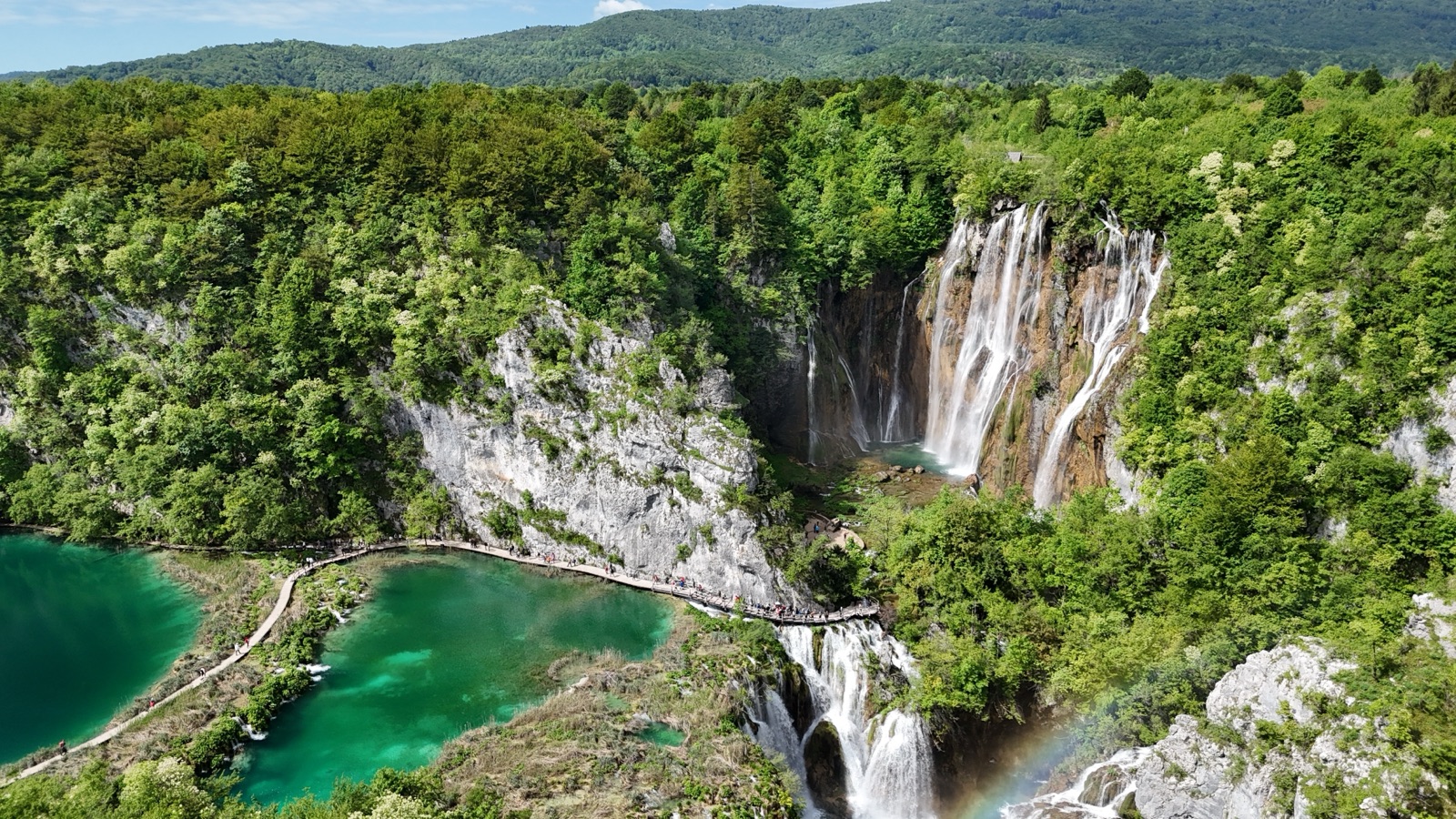
The Plitvice waterfalls are the steps in a staircase of water. Sixteen named lakes drop one into the next over natural dams of tufa, a porous limestone that mosses and algae help to build, and every dam has water spilling over it. The best known is the Great Waterfall (Veliki slap), the highest waterfall in the park and in Croatia. The park gives its first drop as 62 m and its full height, down to the start of the Korana river, as 87 m; many other sources quote 78 m.
The Great Waterfall is also the odd one out. It is not fed by the lakes at all but by the Plitvica stream, which tips over the edge of the canyon at the far end of the Lower Lakes. The other falls are built by the lakes themselves, and they are still growing, moving and occasionally collapsing. This article explains how tall the main falls are, how they form, where the named ones are, and how to see them on a visit.
The short answer
- The highest: the Great Waterfall, at the north end of the park near Entrance 1. Park figures: 62 m to the first lake, 87 m in total.
- The rest: besides the Great Waterfall, the park counts six other waterfalls or cascades higher than 20 m and another twenty higher than 10 m.
- The highest in the Upper Lakes: Veliki Prštavac, a 28 m cascade.
- Named falls worth knowing: Sastavci, where the Korana begins; the Milka Trnina falls between Milanovac and Gavanovac; Veliki and Mali Prštavac; Galovački buk; and the Great Cascades.
- How they form: water saturated with dissolved limestone deposits tufa on mosses and algae, building barriers that dam the valley into lakes.
- Best seasons: the park says the Great Waterfall is at its most magnificent in spring and autumn. In cold winters it sometimes freezes.
How tall is the Great Waterfall?
Ask three sources and you get three numbers, and all of them are honest. The difference lies in where you stop measuring.
The park’s own account of its waterfalls gives the drop from the lip of the fall to the first lake below as 62 m. After that, the water carries on over several smaller cascades, so the total height of the Great Waterfall down to the point where the Korana river begins is 87 m. That makes it the highest waterfall in the park and in the Republic of Croatia.
The figure most visitors meet is 78 m. The Croatian Encyclopaedia says the lakes end in the Plitvice waterfall (78 m), and another article on the park’s own website calls it the 78-metre high Great Waterfall. Croatian Wikipedia reconciles the two longer figures by measuring 78 m to the small pool at the foot of the fall and 87 m to the start of Sastavci.
So which number should you use? If you mean the single plunge you photograph from the boardwalk, the park’s 62 m is its own measurement. If you mean the whole descent from stream to river, 87 m. The 78 m figure sits in between and is the one repeated most widely. Whichever you choose, no other waterfall in Croatia is taller.
A waterfall that does not come from the lakes
Every other fall at Plitvice is water spilling from one lake into the next. The Great Waterfall is different. The park explains that it is formed by the Plitvica stream, whose source is about 3 km away and which does not belong to any of the sixteen lakes.
The stream drops over a cliff into the limestone canyon that holds the Lower Lakes. That is why the fall looks so different from the rest: a tall column of water coming off the canyon wall rather than a wide curtain spilling over a tufa dam between two lakes.
At the bottom, the stream’s water does not stay separate for long. At the foot of the exit barrier of the last lake, Novakovića Brod, the water of the lake system joins the Plitvica stream, and together they form the source of the Korana. The park sums it up neatly: together with the Sastavci falls, the Great Waterfall is the source of the Korana river.
Sastavci and the birth of the Korana
Sastavci is where everything meets. The lakes end in the Sastavci waterfalls, with the Korana springing under the base of the falls. At the end of the Lower Lakes, the water of the Great Waterfall and the outflow of Novakovića Brod come together, spill over the Sastavci falls and become a river.
The river does not settle down straight away. Below its source the Korana runs through a canyon and drops four times more over tufa barriers. Then it sets off on a journey of 134 km to Karlovac, where it joins the Kupa. From there the water travels on via the Sava and the Danube, and the park calculates that it ends a freshwater journey of around 2,070 km where the Danube meets the Black Sea.
Waterfall, cascade or buk?
The park’s naturalists draw a distinction that helps on the trails. A waterfall is a sudden drop of water where the height changes abruptly. A cascade is a stepwise descent, water running down a series of rocks or barriers. In practice the line is blurred, because the barriers keep changing, and some features named as cascades are really waterfalls.
Plitvice’s cascades also have a special character. Because they are created by the formation or raising of tufa barriers, the park calls them rising cascades: they build upwards over time instead of simply being worn down.
You will also hear the word buk, as in Galovački buk. People often use it for cascades, and the park suggests it most likely comes from buka, the Croatian for noise. A group of cascades lined up one after another is often simply called “the falls”.
How tufa builds a waterfall
All of this depends on tufa, also called travertine. The park defines it as a hollow, porous rock formed when plants, algae and mosses help deposit the calcium carbonate dissolved in the water.
The water at Plitvice comes off a karst landscape of limestone and dolomite, so it is naturally loaded with dissolved calcium carbonate. Three conditions have to come together for that to turn back into rock: the water must be oversaturated with calcium carbonate, its pH must be greater than 8.0, and it must carry only a little dissolved organic matter. Where the water speeds up and splashes over a barrier, tiny calcite crystals form and stick to the films of algae and bacteria that coat the rock, the mosses and anything else submerged in the water.
Mosses do much of the building. Freshwater mosses take the carbon they need for photosynthesis from dissolved hydrogen carbonate; as it is used up, calcium carbonate crystals separate out and tufa forms on the moss stems. The moss keeps growing upwards towards light while its lower parts are turned to stone. The species that most often helps build tufa here is Palustriella commutata. Earlier research found 34 moss species at Plitvice; a survey from 2016 to 2019 recorded 44 on the barriers and cascades.
The result is a dam that grows. The park estimates that tufa barriers rise by about 13.5 mm a year, about 17 times faster than sediment settles on the lake floors. Kozjak’s exit barrier grows about 5.6 mm a year, while the barrier at Prošćansko jezero grows three times faster. The active barriers you see today are estimated to be between 6,000 and 7,000 years old, having started after the last Ice Age, and older barriers found higher up beside the present streams are 250,000 to 300,000 years old.
Falls that grow, drown and break
Because each barrier grows at its own pace, a downstream barrier can outgrow the one above it. When that happens, the water level of the upper lake rises until its own barrier, and the waterfall over it, disappear underwater.
The best example is in Kozjak, the largest lake, at 82 hectares, and the deepest, at 47 m by the park’s figures. About 400 years ago Kozjak was two lakes, separated by a tufa barrier and a waterfall about 40 metres high. That barrier, about 400 m wide and about 36 m high, now lies 6 m below the surface. On sunny days you can see it from the electric boat as a pale line in the dark blue water.
For a long time the explanation was simply that the barrier at the lower end of the lake grew faster and drowned the upper one. Dives in autumn 2019 suggested that this may be wrong: divers found the place where part of the barrier probably broke off, creating a 4 m deep channel. Either way, two lakes became one, and a 40-metre waterfall vanished.
Barriers break more often than you might think. Tufa is porous and fragile. The park lists trees falling on barriers and ice melting in spring among the causes, and sudden swings in water level can do the same. When a barrier cracks, the water finds a new path, an old fall can dry up and a new one appears.
The falls of the Lower Lakes canyon
The Lower Lakes are Milanovac, Gavanovac, Kaluđerovac and Novakovića Brod, set in a deep limestone canyon with steep cliffs. This is the setting for the Great Waterfall and Sastavci.
Walking downstream from Kozjak, you pass a chain of cascades between the lakes until you reach the end of the canyon. There the Great Waterfall comes down the canyon wall, Sastavci spills over the last barrier, and the Korana starts below them. A steep zigzag path climbs from the Great Waterfall to the east side of the canyon, which has numerous viewpoints looking back over the lakes and the falls.
The park recently widened the path to the Great Waterfall. Over a stretch of 93 m it was doubled in width, from 1.3 m to 2.6 m, because the path is used in both directions: visitors cannot walk it in a loop, so everyone who goes in has to come back the same way.
The Lower Lakes falls also host a rarity. The moss Didymodon tophaceus, once more common, now grows only in the most open, unshaded places, such as the Milka Trnina waterfalls and the Great Waterfall.
Milka Trnina’s waterfall
One set of falls in the canyon carries a person’s name, and it has a story. Milka Trnina, born on 19 December 1863, was a Croatian opera singer who made her name in Wagner’s operas. On 21 March 1898 she gave a farewell performance of Wagner’s Tannhäuser at the Croatian National Theatre in Zagreb and donated the proceeds to the society that looked after the lakes.
The society’s thanks were delivered on stage after the second act: it named one of the most beautiful sets of waterfalls in the Lower Lakes after her. The park notes that they remain the only waterfalls named after a famous person, and that they were named in her lifetime. Her donation paid for viewpoints and bridges over the lakes.
The Milka Trnina waterfall lies between Milanovac and Gavanovac. It is a good place to stop and look closely at a cascade: the tufa, the moss cushions and the way the water fans out over them.
The falls of the Upper Lakes
The Upper Lakes are twelve lakes on impermeable dolomite: Prošćansko jezero, Ciginovac, Okrugljak, Batinovac, Veliko jezero, Malo jezero, Vir, Galovac, Milino jezero, Gradinsko jezero, Burgeti and Kozjak. They are larger, with gentler and more indented shores, and the park describes this as the more open part of the system, with numerous lakes and waterfalls in the forest.
- Veliki Prštavac is a 28 m cascade, the highest in the Upper Lakes. With its smaller neighbour, Mali Prštavac, it forms the Prštavci falls, which the park calls the biggest and most beautiful waterfalls of the Upper Lakes. Walk close to them and you get the spray.
- Galovački buk takes its name from Galovac, one of the Upper Lakes, and appears in the park’s own photo story about its cascades.
- The Great Cascades are a series of falls with a footbridge across them; the park’s own photo archive shows the pedestrian bridge over the Great Cascade falls.
- Countless small falls link the rest. Between almost every pair of lakes there is a barrier, and over almost every barrier a curtain of water.
In the Upper Lakes the “rising cascade” idea is easy to see: mossy dams with water threading through the plants rather than over bare rock.
Where to see the falls on a visit
All of the park’s programmes take in some of the falls, and the two entrances put you in different parts of the system. Four routes start at Entrance 1 and four at Entrance 2.
- For the Great Waterfall and Sastavci, start at Entrance 1. Programme A passes the Great Waterfall, which the park calls the largest fall of the Plitvice Lakes and in Croatia, then heads upstream through the canyon. Programme B adds the boat on Kozjak.
- For the Prštavci and the Upper Lakes falls, the routes from Entrance 2 cross Kozjak by boat and walk upstream.
- For all of it, the longer programmes cover both halves, and the K programmes walk most of the lake zone, passing the Prštavci waterfalls on the way.
Our tickets and routes guide sets out the programmes, their lengths and times side by side. If you want the Great Waterfall before the crowds, a guided walk that enters at opening time is one option on our tours page.
Wherever you walk, the rules protect the falls. Swimming is not allowed anywhere in the park, it is forbidden to damage the rocks, and visitors must keep to the marked trails. Tufa is fragile, and a footprint on a barrier can break what took years to grow.
When the falls look their best
Flow is everything. The park says you can fully enjoy the Great Waterfall’s magnificence in spring and autumn, and it notes that the appearance of the fall changes through the seasons.
Winter is a different show. In cold spells temperatures sometimes drop so low that the Great Waterfall freezes, which the park calls an unforgettable sight. The light also changes the colour of the water: the park says the colours depend mostly on dissolved organic matter, organisms in the water, depth, the surroundings, the weather and the light, which is why the colours vary from lake to lake and from one day to the next.
For month-by-month crowds, opening hours and what stays open in winter, see our guide to the best time to visit Plitvice Lakes.
A note on Croatia’s other waterfall park
Plitvice is not Croatia’s only tufa waterfall landscape. Krka National Park, in Šibenik-Knin County, has seven waterfalls on the Krka river with a total drop of 224 m. It is not next door, though: Rome2rio puts the drive from Plitvice Lakes National Park to Krka National Park at 114 miles, a little over two hours, so it makes a separate day out rather than an add-on to a Plitvice visit.
Frequently asked questions
How high is the Great Waterfall at Plitvice?
The park gives the first drop as 62 m and the total height, down to the start of the Korana river, as 87 m. The Croatian Encyclopaedia and many guidebooks quote 78 m. All the figures agree that it is the highest waterfall in Croatia.
How many waterfalls are there at Plitvice Lakes?
There is no fixed count, because new cascades appear and old ones dry up as the tufa barriers change. The park says that besides the Great Waterfall there are six other waterfalls or cascades higher than 20 m and another twenty higher than 10 m, plus countless smaller ones.
Where does the water of the Great Waterfall come from?
Not from the lakes. It is the Plitvica stream, which rises about 3 km away and drops over the rim of the Lower Lakes canyon. It meets the water from the lakes at Sastavci, where the Korana river begins.
Which entrance is closest to the Great Waterfall?
Entrance 1, the north entrance. The routes starting there reach the Great Waterfall early in the walk; from Entrance 2 you usually cross Kozjak by boat and walk down through the Lower Lakes to reach it. Our tickets and routes guide compares the options.
Can you swim under the waterfalls at Plitvice?
No. Swimming is not allowed anywhere in the national park, and you must keep to the marked trails and boardwalks. The tufa barriers that make the falls are fragile and easily damaged.